

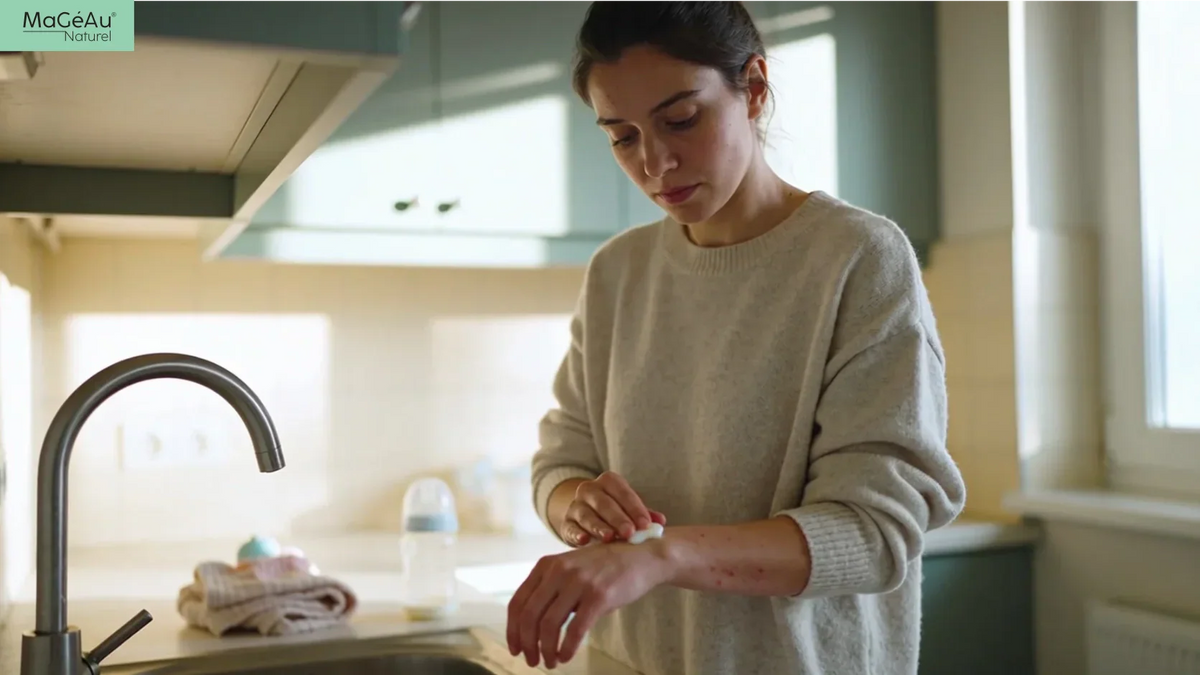
Quelque part vers la deuxième semaine de vie du nouveau-né, entre le calendrier des repas et la pile de linge, de nombreuses jeunes mères remarquent quelque chose d'étrange dans le miroir : leur peau n'a pas l'apparence ni la sensation qu'elle avait pendant la grossesse, et elle n'a certainement pas non plus la sensation qu'elle avait avant la grossesse. La peau post-partum a l'habitude de surprendre les gens précisément quand ils n'ont plus aucune énergie pour s'en occuper. En français, cette frustration exacte est recherchée comme peau réactive post-partum changements hormonaux, et en allemand comme Haut nach der Geburt empfindlich hormonelle Veränderungen. Langue différente, mêmes recherches Google à 3 heures du matin.
Le précipice hormonal dont personne ne vous parle
Voici la partie qui explique presque tout le reste dans cet article : environ 24 heures après l l'accouchement, les niveaux d'œstradiol chutent de leur pic extraordinaire de grossesse à des niveaux inférieurs à la phase lutéale d'un cycle menstruel normal, selon un rapport publié par dermatologytimes.com. Ce n'est pas une diminution progressive. C'est plus proche d'un précipice.
La progestérone chute en même temps, mais les androgènes comme la testostérone ne diminuent pas au même rythme, ce qui laisse brièvement le corps dans un état de dominance androgénique relative. Combinez cela avec une prolactine élevée chez les mères qui allaitent, et vous obtenez le scénario à deux facettes de la peau post-partum : certaines femmes deviennent plus grasses et ont des éruptions cutanées pour la première fois depuis des années, tandis que d'autres deviennent plus sèches, plus tendues et plus réactives qu'elles ne l'ont jamais été. Même événement hormonal, deux scénarios complètement opposés, selon le sens de l'humour particulier de votre peau.
Votre peau n'est pas la seule à se réajuster
Si tout cela vous semble familier, c'est parce que le même effondrement d'œstrogènes est à l'origine de la chute de cheveux post-partum, ce phénomène alarmant de "touffe dans la douche" que la plupart des jeunes mères finissent par rechercher au moins une fois sur Google. Les cheveux qui sont restés en place pendant la grossesse, grâce à l'œstrogène élevé prolongeant leur phase de croissance, sont libérés d'un seul coup lorsque cette hormone chute. La peau subit une version plus calme et moins dramatique du même réajustement : moins visible qu'une poignée de cheveux dans le drain, mais se produisant dans le même laps de temps pour la même raison.
Ce que les données montrent réellement sur la barrière cutanée post-partum
Voici la réponse honnête à la question « quand est-ce que cela revient à la normale » : c'est vraiment plus compliqué que la plupart des articles ne l'admettent. Une étude de cohorte prospective, qui a suivi des femmes depuis la fin de la grossesse jusqu'à six mois post-partum, a mesuré la perte d'eau transépidermique (le taux auquel votre peau perd de l'humidité à travers sa barrière) passant de 9,53 g/m2/h en fin de grossesse à 11,38 g/m2/h à environ un mois post-partum, et jusqu'à 13,80 g/m2/h à six mois, selon un rapport publié par ncbi.nlm.nih.gov. L'élasticité de la peau a suivi la même tendance décourageante, diminuant régulièrement de 0,79 à 0,68 au cours de cette même période, tandis que la rugosité de la peau augmentait.
En termes simples : cette étude particulière n'a pas montré que la peau post-partum retrouvait tranquillement son état antérieur au bout de six mois. Elle a constaté une barrière qui était encore en cours d'ajustement. Ce qui, si vous êtes actuellement frustrée que votre "ancienne peau" ne soit pas encore revenue, est au moins une honnêteté rassurante : vous ne faites rien de mal, et vous ne l'imaginez pas non plus.
À lire également : Pourquoi les femmes appliquent-elles plus fréquemment de la lotion corporelle que les hommes ?
Pourquoi cela se manifeste différemment pour tout le monde
Pour certaines jeunes mères, cette fenêtre de dominance androgénique, associée à une prolactine plus élevée, se manifeste par de l'acné post-partum le long de la mâchoire et du menton, souvent chez des femmes qui n'avaient jamais eu d'acné adulte auparavant. Pour d'autres, en particulier celles ayant des antécédents d'eczéma ou une peau généralement réactive, la chute d'œstrogènes (et la réduction d'acide hyaluronique et de lipides de la barrière cutanée qui l'accompagne) fait pencher les choses vers la sécheresse, la tension et les poussées, à la place. Il s'agit du même événement hormonal sous différentes formes. Aucun des deux ne signifie que vous utilisez les mauvais soins de la peau.
Le manque de sommeil et le stress aggravent la direction que prend votre peau. Le cortisol ne prend pas de pause juste parce que vos hormones sont déjà occupées à se recalibrer, et le stress chronique est bien connu pour ralentir la récupération de la barrière cutanée par lui-même, indépendamment des niveaux d'œstrogènes. Donc, si à six semaines post-partum, vous avez l'impression que votre peau livre une bataille sur deux fronts, c'est parce que, en un sens, c'est le cas.
Ce à quoi vous ne vous attendez pas : les mains, les lèvres et les zones dont personne ne vous parle
Le visage et le corps attirent toute l'attention, mais la vie de jeune parent malmène aussi discrètement quelques autres zones. Les mains sont mises à rude épreuve par les lavages constants, la désinfection et les changements de couches, parfois des dizaines de fois par jour, plus de lavages de mains en une seule semaine que la plupart des gens en un mois avant bébé. Les lèvres sont gercées par la déshydratation, la respiration buccale pendant le sommeil épuisé et, plus généralement, le fait d'être en bas de la liste des priorités de soins personnels pendant un certain temps. Aucune de ces zones ne reçoit beaucoup de sympathie dans la conversation générale sur les « soins de la peau post-partum », qui a tendance à se fixer sur le visage, mais les deux remarquent le même changement hormonal et de mode de vie que tout le reste.
À lire également : Comment puis-je rendre mes lèvres naturellement roses
Ce qui aide vraiment
Rien de tout cela n'exige une nouvelle routine compliquée, ce qui est une bonne chose, car une nouvelle routine compliquée est la dernière chose pour laquelle quiconque a de l'énergie après l'accouchement. Cela demande des bases axées sur la barrière cutanée qui fonctionnent sans y penser. Un gel douche au magnésium est vraiment utile ici, nettoyant en douceur pendant la douche la plus courte de votre vie sans laisser la peau plus tendue qu'elle ne l'est déjà. Une lotion corporelle au magnésium appliquée juste après cette douche, pendant que la peau est encore légèrement humide, aide à compenser l'augmentation de la perte d'eau que la recherche ci-dessus a réellement mesurée, plutôt que de simplement la masquer pendant une heure.
Et une lotion pour les mains au magnésium gardée à chaque lavabo de la maison (sérieusement, chaque lavabo) tient compte de la seule partie du corps qui est lavée plus que toute autre en ce moment. Des applications petites et fréquentes sont plus importantes ici qu'une seule application lourde au coucher.
Si vous voulez une version la plus petite possible : gel douche, lotion corporelle sur peau humide juste après, lotion pour les mains réappliquée chaque fois que vous vous en souvenez (vous ne vous en souviendrez pas toujours, ce n'est pas grave non plus). C'est toute la routine. Rien dans la vie de nouveau-né ne laisse de place à plus d'étapes que cela, et rien dans la peau post-partum n'exige plus que cela non plus.
Une dernière chose à vérifier : le parfum
La peau post-partum, déjà plus réactive en raison des hormones et de la négligence due à l'épuisement, a tendance à remarquer le parfum beaucoup plus rapidement qu'avant. Il est utile de vérifier réellement les étiquettes plutôt que de supposer qu'un produit que vous tolériez bien il y a deux ans est toujours une valeur sûre.
À lire également : Les dangers cachés des parfums dans les produits de soin de la peau
C'est encore plus important si vous allaitez, car votre peau est en contact constant avec celle de votre bébé, et la barrière cutanée d'un nouveau-né est encore moins équipée pour gérer le parfum et les irritants que la vôtre actuellement.
À lire également : Produits de soin de la peau hypoallergéniques sans parfum pour les patients atteints de cancer
En fin de compte
Une peau post-partum qui réagit plus que d'habitude n'est ni un mystère ni un échec personnel, c'est un changement hormonal et de barrière documenté que la recherche continue d'explorer activement, et il ne se résout pas toujours selon le calendrier précis promis par Internet. Ce qui aide réellement en attendant est peu glamour mais fiable : un nettoyage doux, un soutien constant de la barrière cutanée, une prudence vis-à-vis des parfums, et de la patience avec un corps qui vient d'accomplir quelque chose d'énorme.
Votre peau retrouvera son équilibre. Peut-être pas selon le calendrier de quelqu'un d'autre que le sien.
Avis de non-responsabilité : Cet article est destiné à des fins éducatives et informatives uniquement et ne constitue pas un avis médical. Consultez toujours un dermatologue qualifié ou un professionnel de la santé avant d'apporter des modifications à votre routine de soins de la peau, en particulier si vous avez une affection cutanée existante.


Commentaires (0)
Il n'y a pas de commentaires pour cet article. Soyez le premier à laisser un message !